Credited as the Scottish father of acid house, Egebamyasi (or Mr Egg) has been pioneering the space age acid sounds since before the genre even knew what to call itself. After starting out in punk bands in the early 1980s, Egebamyasi somehow managed to get his hands on a rare 303 synthesiser, which kicked open the doors to a life as one of the founding figures in the McAcid and European acid house scenes. Who better to lead our annual acid house rave at The Beech Plateau? We catch up with Mr Egg about the early days of UK dance music, his adventures with the likes of Vince Clarke and A Guy Called Gerald, and the reasons why, after 40 years in dance music, he still prefers to play live(gg)…
Listen to his guest mix for us here and read our Q&A below…
Kelburn Garden Party: Hi Egebamyasi! Can you start by introducing your mix to us?
Egebamyasi: I might do something completely different to what people expect. I’ve been getting back into garage. It’s pretty tasty, that’s for sure. It stands out. It’s almost like slowed down jungle or drum & bass, but it’s pretty meaty, so that will be the set I’ll put together.
KGP: Let’s go right back to the beginning. You’ve been creating acid house for 40 years now, but how did you get started in music?
Egebamyasi: When the punk thing started, you just wanted to do something. You mucked about, picked it up as you went along, and then found people to join up with. The last band I was in, playing the bass, was a band called The Mississippi Groovers. We used to rehearse near Dunblane and there were a few other bands that rehearsed in the same place. During a break, I went over to see some guys in another band, and bizarrely they had this machine – this Roland TB 303.
The sound of the 303 was quite electronic and unique, and I just took to it. This must have been about 1983. Who knows how this machine ended up in Dunblane at that time, because there were only 10,000 of these 303s made. I managed to borrow the machine, but it took me a few years to realise that what I was doing with it was making what went on to be known as acid house.
This machine blew me away. I learnt how to work it and get noises out of it, and it took off from there. It was not planned. It was an accident. I used to listen to John Peel in the early 80s and he would play an occasional acid song. Stuff eventually came together, realising that what I was doing in Stirling was being done elsewhere in America and London. To me, it was a kind of bizarre disco – there was no name for it.
The first piece of equipment I bought was the 909 in 1990 for 500 quid. I got a couple of these machines for free because nobody was interested in playing with them. Nobody knew what these machines were going to become. If you took away the 909, the 808 and the 303, then dance music, techno, trance and all that could have been completely different.
KGP: Do you remember what tracks you heard on John Peel that let you know you were part of a wider acid house movement?
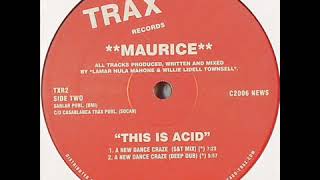
Egebamyasi: The first one that I can remember was “This Is Acid” by Maurice. When I heard that, I still didn’t realise that that bass sound was from the 303 I had, because some of the basslines were quite different. Another couple around the same time were “I’ve Lost Control” by Sleezy D and Bam Bam “Where’s Your Child”. But “This Is Acid” was the one that kicked it off for me.
KGP: What was that like for you, realising that that sound was going on elsewhere?
Egebamyasi: I wasn’t thinking much about it because, apart from doing the acid stuff, I was still getting into other guitar bands. It wasn’t until later, around 1990, that I realised what exactly was happening. I had the same management as A Guy Called Gerald and worked with him for a weekend, and it was about then that I realised. I went down to Manchester and we jammed for a weekend in his loft.
There was a tape that was made but unfortunately got lost. I think I may have sent the tape to Belgium to get transferred onto CD. That cassette might resurface somewhere, which would be good. I remember some of his noises and some of my basslines. It was a really unique piece of history.
KGP: That tape is in someone’s loft now.
Egebamyasi: It’s gone in the rock n’ roll archive.
KGP: You were influenced by artists like Can and Captain Beefheart. What was it about their sound that inspired you when you were playing with the 303?
Egebamyasi: They’re really abstract. It’s a bit of an acquired taste. I don’t think you would put a Can or Captain Beefheart album on to lighten the mood. You have to be a bit of an enthusiast to like that kind of stuff. Their music never really influenced the acid, but it was the attitude they had – being unusual, different, a bit daft and a bit silly.
To me, the similarity in the music is that it’s unique. It’s not easy to listen to and it’s not easy to write. When I used to listen to acid house on John Peel, I used to think, “What are these people like, to be writing this kind of music?” It was like nothing anybody had ever heard before.
KGP: What was the first release that you feel represented your sound?
Egebamyasi: Probably Acid Indigestion #2. That was on Groove Kissing and the main track was “Bubble”. There were two before that. Acid Indigestion #1 was quite a ferocious piece of techno that apparently went down quite well in Goa. But I would have said that Acid Indigestion #2 “Bubble” was the one that properly kicked it off. Saying that, I did three records in Amsterdam in 1991 and that’s what opened the door for me as far as Europe went.
KGP: How did you get picked up by Groove Kissing?
Egebamyasi: Before Egebamyasi really took off, I used to do the merchandise for a band in Edinburgh called Finitribe, and the guy that I was doing stuff with at that time was a sound engineer. We were the support act as well as the sound engineer and the merchandising seller. We played with them at the Milky Way in Amsterdam in 1990. There were just a couple of guys, I’m selling the t-shirts, and a guy from Groove Kissing came over and said to me, “Do you want to send us a demo tape?” I’ve done much more professional demo tapes before, but when they got the tape, they were up for it. I ended up back over in Amsterdam and got three records out of it.
The studio in Amsterdam was owned by Vince Clarke. When I was there working up the stairs, he’s got a studio down the stairs. One day, I went to make a cup of tea and he was there with his main technician. I was married at this time and I thought, “It’s a bit uncool, but I’m going to have to ask him anyway,” so I asked him for his autograph for my wife. He went away to the studio and brought back this sheet music and he wrote: “To Mr Egg’s Wife…” That was the start of a relationship with him. He ended up doing a mix for me on a tune that was completely unrelated to acid.
KGP: When performing, you tend to play live rather than DJ. What’s your setup like?
Egebamyasi: From the early 90s until the late 2000s, all the music would have been prepared in-house. If you’re busy playing the patterns in pattern play, you can’t manipulate anything other than the tones, so everything was pre-programmed in the bedroom and jammed live.
But since Roland and Behringer made new equipment, you could write as you were playing. You could add drums, take drums away, go with the flow of the crowd. Writing on the 303 live would be too much, but there is a x0xb0x, which is a 303 clone, that you can write on. The good thing about it is instead of spending weeks and months writing drums, I’ll just put a basic set of beats in. If I’m playing live now, the drums will all be written and jammed on the night.
That transformed the live thing for me because I like to be busy. I’m no DJ but I have DJed, and I just feel bored. I’m not a dancer. I’m not a showman. I’m a musician. I like to be hands on. For that hour, I’m in a zone of my own. Just focus on the machines, because there’s a lot to think about. You’ve got to pay attention and not let the thing run away from you, trying to remember where this pattern is to go with this pattern. There’s a lot of stuff going on in your head apart from just pressing buttons when you’re playing live.
KGP: Can you share a favourite memory from Kelburn Garden Party?
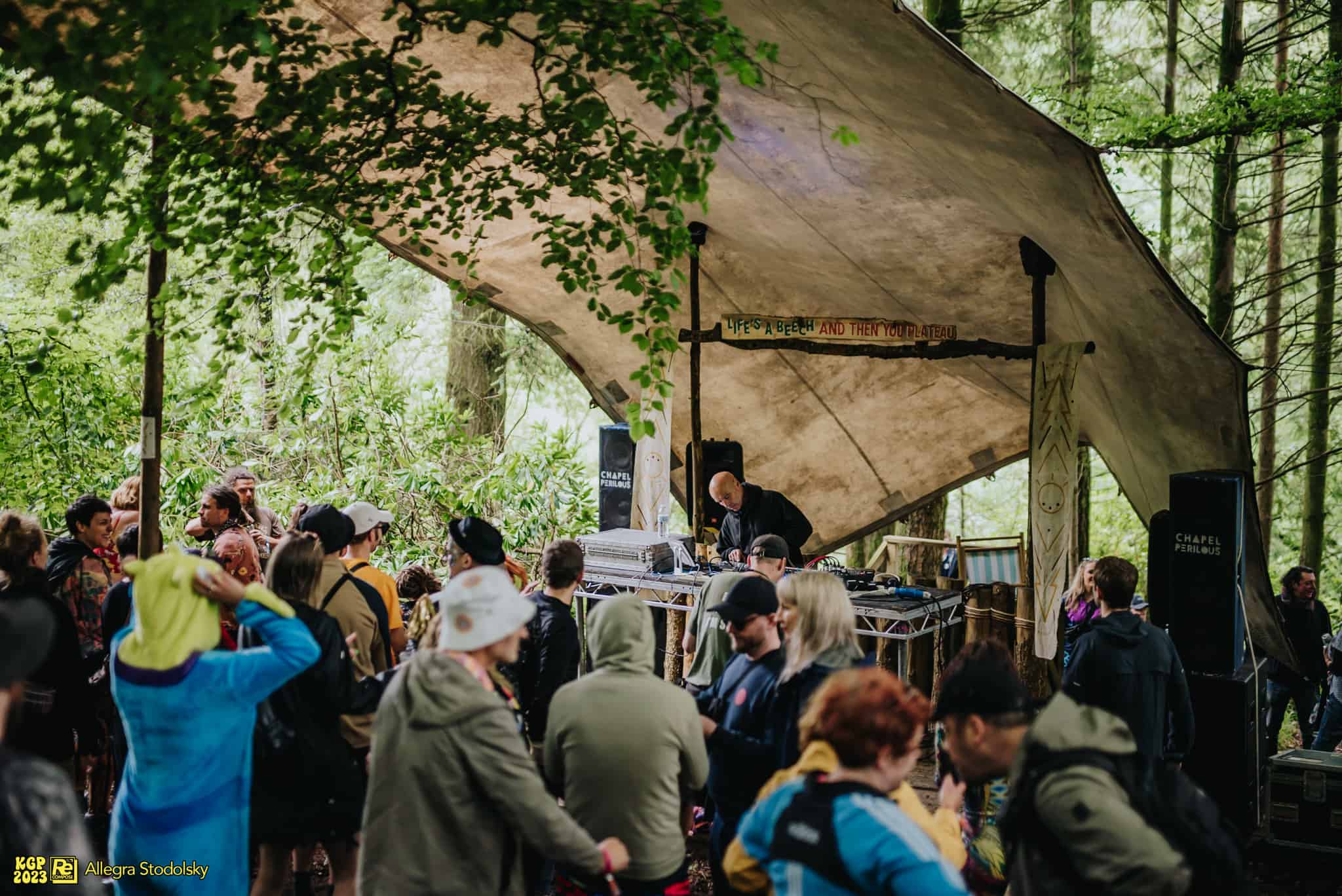
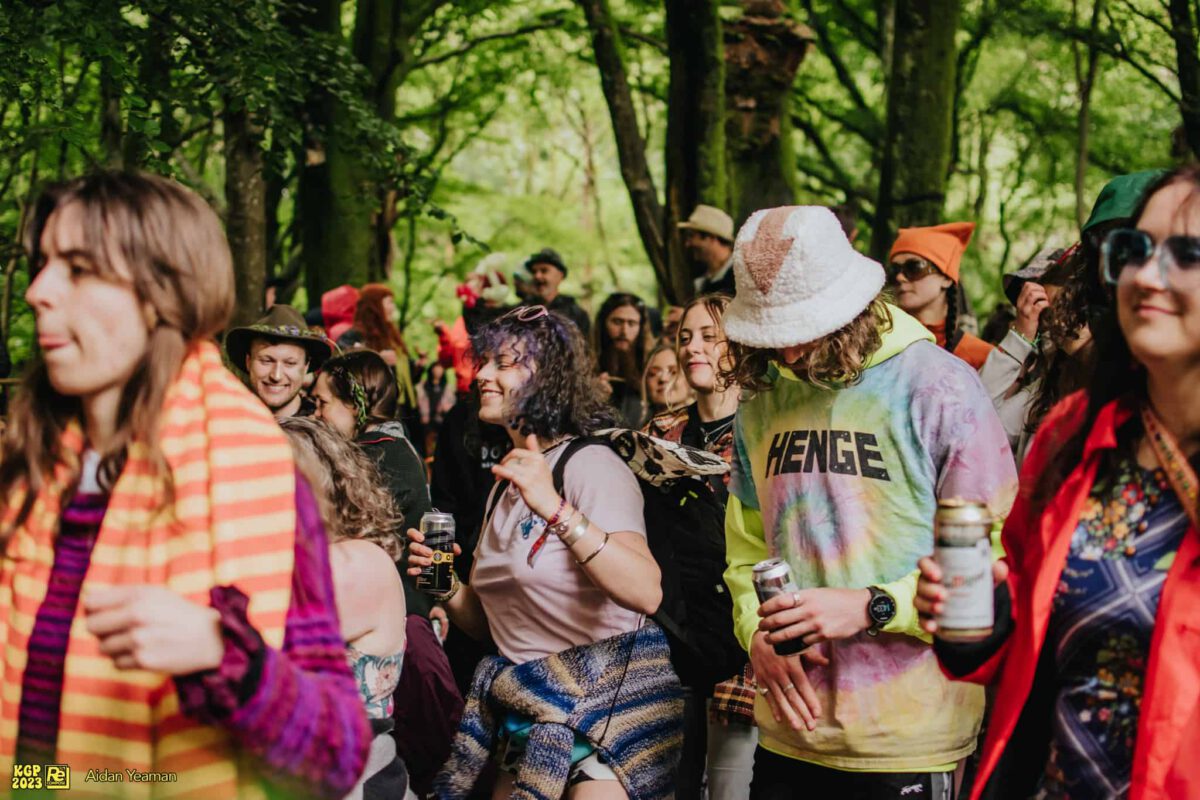
Egebamyasi: It was a bit bizarre for me because I don’t normally play in daylight. It was quite unusual, playing up at the Beech Plateau, to see people’s faces. The look on their faces when I did pay attention was really amazing. There were three girls dancing to my left, and they were absolutely going off their nut. When you see something like that, you think, “This is working, they’re obviously feeling what I’m feeling.” That’s what gives you a buzz, apart from playing.
When we went back down to The Landing Stage, Mrs Magoo was on and Coco Bryce. For me to like a DJ is a bit rare, but that four or five hours when it got dark was pretty good. I thought at the time, “I want to be on that stage.” It was one of those nights when you’re really envious to be out standing there.
Thanks Mr Egg!