
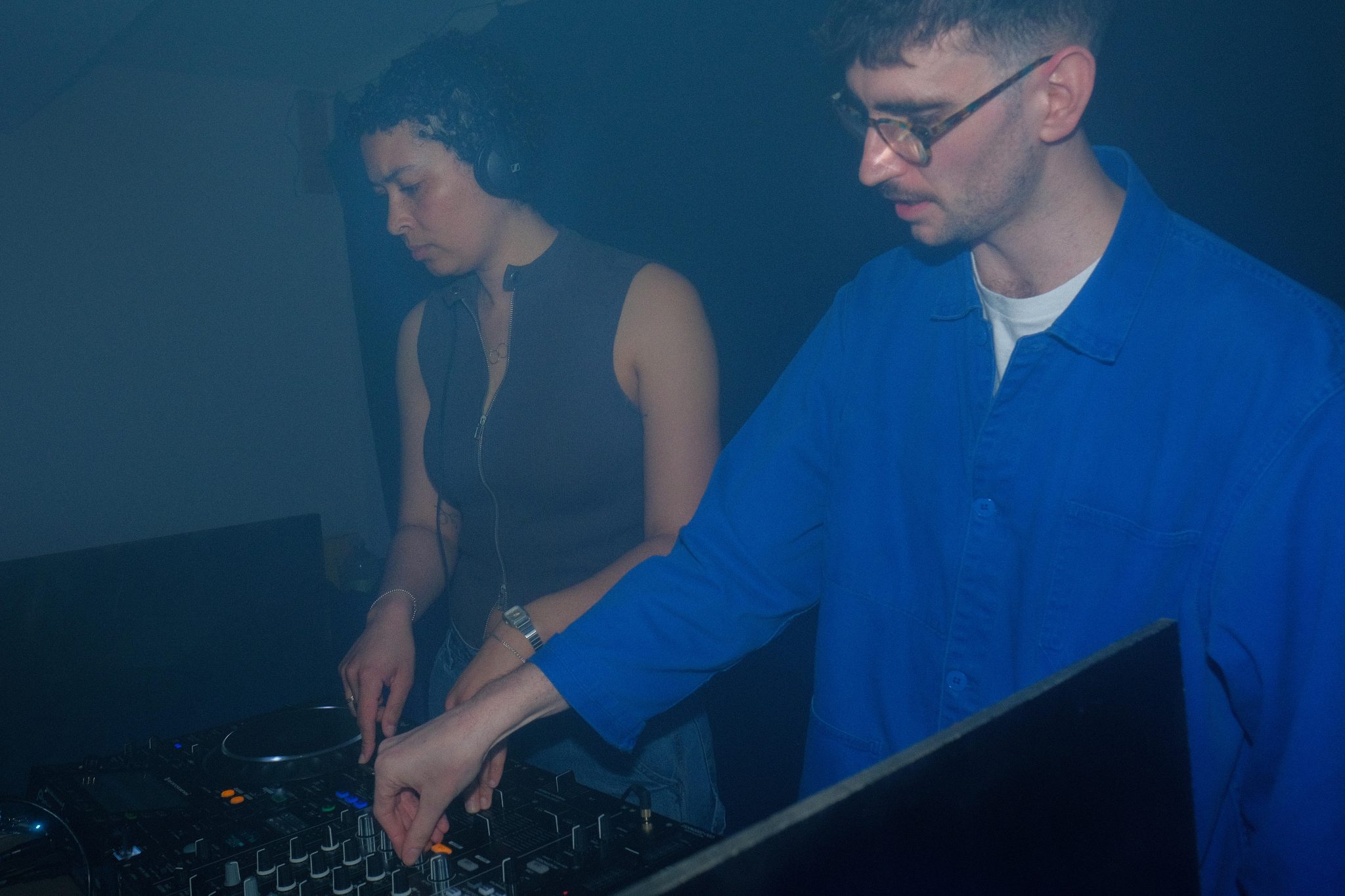
Calling in from Ullapool (via Edinburgh, Glasgow and London), baile/baile have created a buzz these past couple of years with their new Highland enclave for quality dance music. Several times a year, they create a space for Ullapool’s ravers to come together and throw down to club culture’s broad spectrum of music, while drawing friends and fans curious about this growing scene into the distant north. They’ve gained the attention of household names such as Alan Cumming and the BBC – but mostly importantly, they’ve injected a new energy into north Scotland’s unique electronic music scene. We caught up with them about Andrew Weatherall, an afters culture with a Highland flavour, and their origins in Kelburn’s Saloon Bar…
Hi baile/baile! Can you introduce your mix for us?
Sigi: When we play together we straddle a few different genres, which are based around grime, garage, electro and those darker genres that are pretty ready for the club, but for this mix we’re reflecting how euphoric an experience Kelburn is. I think we’re going a bit more fun and fresh. Something that will work well leading up to the festival – something that’s about remembering the sunshine of last year and how fun it was to be in the Glen.
What music did you grow up listening to, and at what point did you first experience dance music?
Sigi: I grew up in the Highlands of Scotland, which is hugely Trad focused. I grew up playing the pipes (not very well, but I played them) and being part of a lot of traditional music. Our school had an excellent music department. Genuinely some of the best musicians in the country come from my tiny, wee school in Ullapool. I realised that I wasn’t that amazing at actually practicing and being good, so I got into sound teching. I used to tech all our school assemblies, which were essentially massive concerts with 10-piece pipe bands and fiddles and accordions. And then I transitioned into radio when I came to university. The other thing that massively got me into dance music was being in Sneaky Pete’s. I was going to Sneaky Pete’s all the time for gigs, and then transitioned to going for the club, and the community around EHFM, Sneaky’s – I think that’s the main thing I take away from dance music. As well as a love for tunes and dancing, a big community of people that are all really lovely and all really passionate about what they do, which is really infectious.
Jemima: My first ever proper clubbing experience was Brodinsky supporting Andrew Weatherall in London. It felt like a formative experience to me. It was crazy. I got really into techno and Brodinsky and Gesaffelstein when I was 17. As soon as I turned 18, I was so excited to be able to go out and see one of those in London. To see Andrew Weatherall as my first ever proper clubbing experience, I feel, is pretty nuts.
What was the dance music scene like in Ullapool before baile/baile landed?
Sigi: Apart from a massive rich musical heritage, Ullapool’s always been really into dance music. People loved it. We had a radio station in Ullapool that was started by local DJs. Dulcie, who does our sound system for our parties up north now, was one of the founders of Lochbroom FM and used to put parties on in the late 90s, early 2000s. There was always that scene, but it’s been something that’s done in private in people’s houses. There’s never been a club. We’re too small to have a club, so it was always the pub, and then you might have something like an afters. It’s much more of an afters culture than a club culture. But those two things are massively intertwined. Now with our parties we have a really big age range come along. We’ve got young folks that are new to clubbing, and then we’ve got people that come and say, “I used to be a raver back in the day, and this is taking me back to what it was like.”
How did you come to set up baile/baile?
Sigi: I’d always had this idea of doing a festival or something up in Ullapool. There’s an island called Isle Martin, which is community-owned, just north of Ullapool, and I’ve always thought it’d be amazing to do a festival on the Isle of Martin. Jemima was like, “I’d love to start putting on a party,” and then those ideas combined. I was like, “Well, we could do something up north.” It felt more accessible in terms of we’d be the only people doing it. I thought it would contribute something to the village. It would be novel. It would be easier to carve out an audience, weirdly, than in Edinburgh, because you just have to get the village to come along. You’re not targeting a really specific genre.
From my side, it came from noticing that the music scene and the cultural scene in the Highlands was rapidly diminishing, and has been over the past decade or two. When I was growing up, my mum would take me to the theatre in Ullapool once a month at least, and we’d go see music, opera, ballet, theatre. The Ceilidh Place had all that in spades as well. We had Loopallu, the music festival, the book festival, the guitar festival, and Fèis Rois, which is another traditional music school. It’s mad. For a tiny village, it massively punched above its weight, and now you’re lucky if a third of that is still active, because nothing’s subsidised. There must be a vacuum that’s been left behind.
Jemima: The way we run the parties has been quite unique from the start too – it’s definitely more of a challenge to get the Ceilidh Place to function as a club than it would be at a normal venue in Edinburgh and Glasgow. And there has been a real feeling of wholesomeness and community within that.
Travel will usually be both of us driving up with the DJs, ending up being just a four hour chat in the car, and really getting to know a lot of them quite well. Most of the time the artists will stay at Sigi’s mum’s house too, and we go for a nice walk or swim the next day. Although the party is the key element, playing at a baile/baile event does end up being a bit of an excursion, and one that artists have really enjoyed which has been nice – even if it is quite different from your usual club night. I was playing at Dansa’s night in Edinburgh recently, and before the event we were laughing about how I had to stop at someone’s house on our way up to Ullapool to collect the decks!
What was the reception like when you first started the club night?
Sigi: Honestly there’s been nothing but support from the local community. We sold out our first night, which was pretty unbelievable and such a vouch of trust. Then it just snowballed. The BBC came to our second ever party. We’ve had people writing about us in loads of newspapers and magazines, and we’ve done bits and bobs with Alan Cumming. But the core of that is still locals. We did four nights immediately, once a month, and we sold out all of them. That was pure locals and some friends coming up. We’ve got a wee community of people that come to every single one, that are the first people to buy tickets. The thing that was really lovely was everyone got on board. We got a relatively good deal with the Ceilidh Place – we don’t pay to hire. They take bar, we take door. Dulcie, who provides the sound system, gives us a good price for that. People help us out in lots of different ways. Everyone has tried to make it happen.
What’s the music policy at a baile/baile night?
Sigi: Just good music. We specifically try to vary the sounds. Lewis Lowe, who’s playing our Kelburn lineup, was like, “It’s hard to pin down a baile/baile sound.” We’re like, “Good.” I think in the city, your niche is either you’re representing a sound or you’re representing a community. Quite often a sound comes with a community, so they’re more tied. Our first night was Smiff and Moray Leisure Centre, who are very UK bass and hard drum, which is what we really love. And then we had our second one, which was quite house oriented. Then we had a pretty hardcore night with Miss Cabbage and Joey Mousepads. Our last one was a bit more mixed. We had Massie and Feena, and Massie is so eclectic. You’ve got to keep it varied. That’s something for Kelburn we’re doing as well. We specifically have a really wide range of music on our lineup.
Jemima: Sigi and I have said throughout our events, in Ullapool as well as Glasgow and Edinburgh, that really the only thing that you could pinpoint for our parties is that the music has been great. Every night that we have put on has had a totally different sound, and this is something I hope we’re able to maintain through our future events too.
There is such a wealth of talent in both Glasgow and Edinburgh, and it has felt really special to be able to showcase this up north, and to be able to show these DJs how they like to party in the highlands.
How does clubbing in Ullapool compare to London?
Jemima: Community is definitely one massive aspect for me. I feel like in London, often you go to the club because you’re aiming to see a DJ. But with the parties in Ullapool, it’s definitely been more community-focused, and it’s much more about the people that you see when you’re there. It is really lovely that we have a set of regulars that come every single time. That’s really sweet. There’s a huge sense of community at the club. I mean, there definitely is as well in London. It’s just a different landscape. And, obviously, it’s a far more established scene in London than in Ullapool.
Do you have any big plans for baile/baile’s future?
Sigi: Our hopes were to play kelburn!
Jemima: Yeah, nearly three years ago now, me and Sigi were standing in the crowd at the Saloon Stage, being like, “Oh my god, we should ask that person to play our very first baile/baile party.” So it’s absolutely insane that we’re now doing a takeover at the Saloon Stage.
Sigi: It was Clara, Moray Leisure Centre. For our first one, all our headliners were from the north of Scotland, and we were told that Clara was from Forres. We’re like, “We should ask Clara,” and now she’s a friend, and we brought her back. It feels pretty mad.
Jemima: I guess as well, a slight expansion into the north of Scotland. All of our parties have been in Ullapool, so we’d really like to start doing a couple in some of the surrounding towns and villages. That will be a bit more of a challenge, as we are quite established in Ullapool. I think it’s going to be a really fun expansion for the party.
Can you share a favourite memory from Kelburn?
Sigi: We’ve only been twice and already there’s too many. For me, I think the first year we went, just being in Saloon. The first year was hosted by Miss World, who we love, love, love. Feena’s like our god. Being there for that whole day and being around lots of people that we really love on that stage was a beautiful memory. Last year, being up at the Boat in the sun…
Jemima: The Boat stage in the sun was my dream. There’s a video that someone took – you could see us all dancing and staring out onto the sea, and we look so unbearably happy. It’s so good. I love it.
Sigi: The Sunday where we sat in the sun all day at the Boat. And then Casement did his set where he switched the vibe up and it was just so brilliant.
Jemima: I think one of mine was us planning as well. We talked about baile/baile, and we started to line up some people. I really can’t believe that we’re now doing it.
Sigi: Kelburn, I think, was the point where we were like, “Yeah, let’s do this.” We were toying with it. We spoke to a few people at Kelburn, and we were like, “This is what we’re thinking about doing,” and everyone was like, “Yeah, do it. That sounds really fun.” We came away from Kelburn on a mission.
Thanks baile/baile! Catch you in the Saloon…